


Plant-based leathers are one of the fashion industry’s most exciting innovations. Imagine purses, jackets, and shoes all made from coffee grounds, bamboo, coconut husks, date seeds, and even apples. Elke Steijns, founder of VOGAYA, shares why she feels the industry’s most stylish (and sustainable) revolution starts now.
Imagine your morning cup of coffee becoming a luxury handbag. Not the caffeine, I mean, rather the grounds, the part you scrape out of the machine and throw away without a second thought. That’s not a thought experiment. Leather made from coffee grounds exists. It’s also a material that Vogaya uses in our handbags, and an example of a much bigger shift in how we think about materials, and leather in particular.
The possibilities for alternative leather are endless.
When I hear people talk about making fashion more sustainable, the conversation often centers on fast fashion, overconsumption, and recycling. These are all important topics, but there is another issue in fashion that I believe has been given a free pass for far too long: leather.
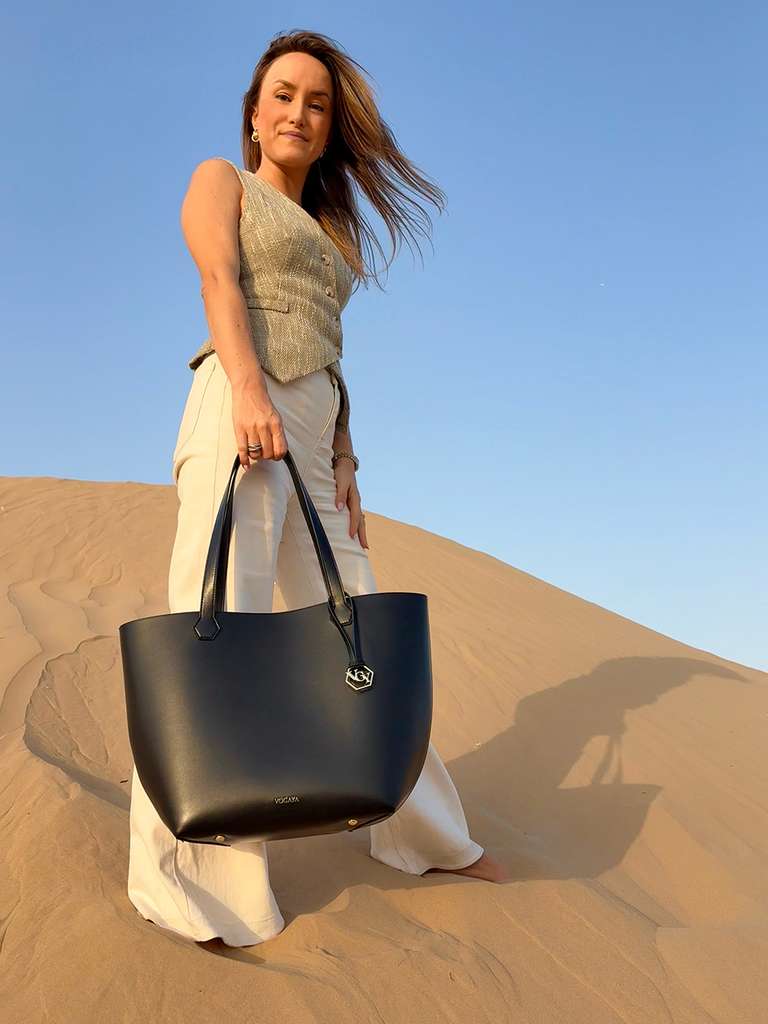

Leather has become synonymous with quality, craftsmanship, and luxury, and we have become very good at separating the word “leather” from what it actually means. Many people simply aren’t aware of what sits behind that word: the animal, the environmental impact, the pollution, and the chemicals involved in transforming skin into the leather we know. There’s also a common misconception that leather is simply a by-product of the meat industry. In reality, hides are valuable co-products with their own global market, and the livestock system behind them is enormous: methane and nitrous oxide emissions, vast land and water use, deforestation, biodiversity loss.
Then comes tanning, which turns a hide into leather using large quantities of water and chemicals including chromium compounds, some classified as carcinogenic. The wastewater can carry chromium, sulphides and salts, and the UN has specifically identified tanning as a source of environmental and human-health harm, including for the tannery workers who handle these materials daily.
None of this is visible in a luxury boutique. We see the craftsmanship and the price tag, not the animal, the pollution or the process. I didn’t question it for a long time either. Only when I became aware of the realities of animal agriculture did I start questioning my own consumption. I realised I didn’t want any part of it, and adopted a plant-based lifestyle. Naturally, that led me to question more than just what I ate. What I wore and what I bought suddenly mattered too.
Then I hit a practical problem: finding a beautiful handbag that matched those values was surprisingly hard. Most luxury bags were animal leather, and the alternatives were mostly plastic-derived, like PU (polyurethane, an element often used in synthetic leather). So I wondered: can I build a handbag brand from better materials? That question became Vogaya, founded here in Dubai.
Because the way we consume shapes what gets produced. If consumers become more aware of the true impact behind materials, they can make different choices. And when enough people make different choices, industries have to respond.
Elke SteijnsRather than starting with animal skin, we start with plant-leather, and the difference isn’t just where the material comes from; it’s what doesn’t happen to make it.
Our coffee leather starts with spent coffee grounds (collected before they’d otherwise be discarded), then dried and processed into a fibrous base that can be bonded and finished into a durable material. There’s no hide to preserve, no animal to raise, and none of the chromium tanning that pollutes water and puts tannery workers at risk. Our bamboo leather works the same way: bamboo regrows from its own root system, so there’s no replanting, no herd, and the material can be processed without the heavy chemical load conventional tanning requires.
Plant-based leather is a much bigger movement than just us at Vogaya: scientists and material innovators around the world are developing plant-leather from coffee, mushrooms, pineapple leaves, apple waste, grapes, and cactus (and designers are turning that science into bags, shoes, and accessories that didn’t cost an animal or a rainforest). Here in the UAE, where date seeds alone add up to over 100,000 tonnes of waste a year, there’s an open question waiting to be answered: what else, sitting in our own waste streams, could become the next material? In fact, date seeds are one of many potential plant-based leathers currently in development.
Choosing to purchase these beautiful, less-toxic textiles leads to greater innovation and research, offering producers and consumers unique options created from local materials.
Fashion has changed before. Fur and exotic skins are not the status symbols they once were; knowledge of fur and breeding farms has reduced their popularity. Luxury has always been associated with innovation, so why shouldn’t the next generation of luxury materials come from plants, waste streams, and new technology?
Plant-leather isn’t perfect, and it doesn’t have to be. No animal is harmed to make it. It skips the chromium tanning and deforestation, and even while some alternatives may still use synthetic binders or coatings, the overall footprint stays well below animal leather’s. That’s a real head start, yet it isn’t an excuse to stop improving.
Because the way we consume shapes what gets produced. If consumers become more aware of the true impact behind materials, they can make different choices.
And when enough people make different choices, industries have to respond.
Why choose harm when we can choose kindness? For me, that is where the future of luxury begins, and where I want Vogaya to lead the movement.
