


The addax antelope is one of the rarest species on Earth. Thankfully, there’s a global plan already in the works: repopulate the species with cooperative conservation. Enter Dubai Safari Park, and its thriving addax breeding program.
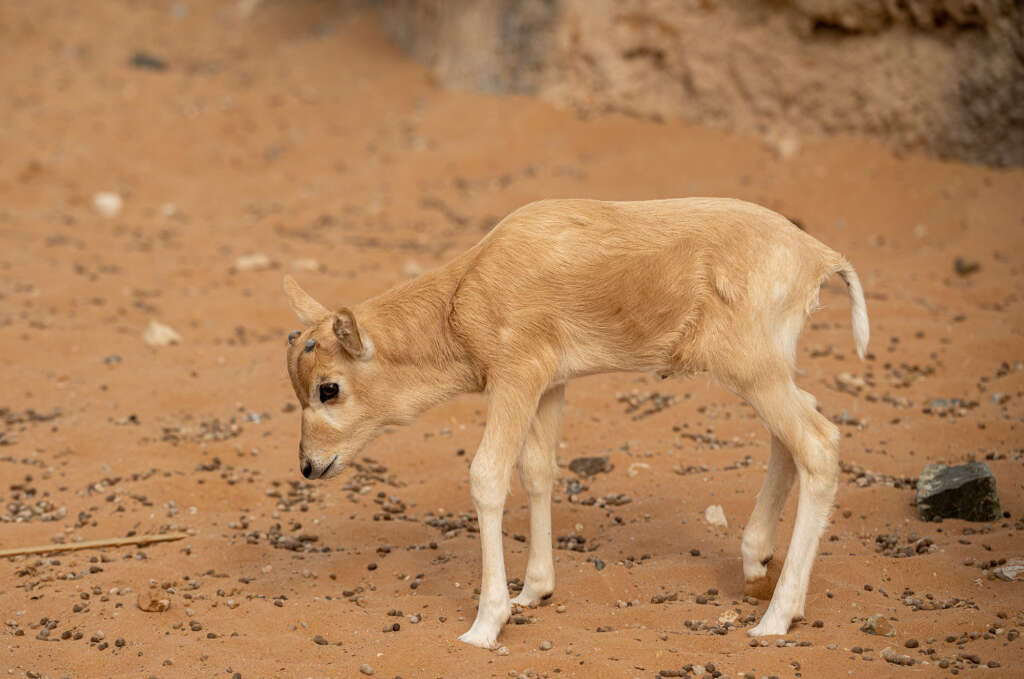
A tiny, slender-legged calf carefully follows its mother across the sand; its X-shaped facial markings add an air of distinction. The nubby newborn horns, just beginning to sprout, will eventually grow into substantial corkscrews, standing almost 85 cm (33 inches) tall in males.
These elegant animals are known as the addax antelope (Addax nasomaculatus), a cousin of the Arabian Oryx; it is one of the rarest species on earth.
Once found in large numbers across the Sahara Desert, this critically endangered species now faces extinction, with numbers plummeting to fewer than 90 mature individuals in the wild.
And when we lose even a single species, the damage to the landscape is immense.
As one of the largest grazing animals in the Saharan desert and arid steppe, addax play a crucial role in balancing the ecosystem, returning critical nutrients to the soil. They’re also culturally significant with symbolic value in their native region – their decline impacts both ecological stability and cultural heritage.
While these numbers may seem bleak, hope is not lost.

A Herd Away from Home
Dubai Safari Park is in charge of an addax herd, eventually on track to be reintroduced to wild populations in Chad. And this is not a unique setup; thousands of addax are well cared for in ex situ populations around the world. (For definition, ex situ conservation methods involve breeding and caring for species outside their natural ecosystem; essentially acting as modern-day Arks)
Zoological institutions such as Dubai Safari Park collaborate in global breeding programs to maintain healthy genetics within threatened species.
It was a goal of the late Sheikh Zayed to support the conservation of oryx and their relatives. In a landmark conservation effort in cooperation with the Sahara Conservation Organization, Dubai Safari Park is helping to fulfil this goal by sending 14 addax from their breeding herd back to Chad, as part of efforts to save the species from extinction.
Katie Zimmerman, a conservation specialist, believes repopulation for the addax is completely possible.
We spoke to Katie, who manages conservation programs at Dubai Safari Park, one of several UAE partners contributing to the project. Katie explained that these recent efforts are part of a larger, decade-long project between the UAE and the government in Chad.
“There’s so much that goes on behind the scenes,” Katie reveals. Aside from their day-to-day care, all animals regularly receive enrichment to encourage natural behaviours, mental stimulation, and exercise. All things that help encourage resilience and adaptability.
For Katie, the animals at the park are ambassadors for their species. “We want our visitors to care about these endangered animals; we want people to feel educated and empowered to do their bit to help wildlife.”
Although visitors may not be aware, Dubai Safari Park conducts research that supports conservation efforts, Katie reveals. In fact, the Life Science team recently published a study about the feeding patterns and nutritional needs of oryx and addax.
We want our visitors to care about these endangered animals; we want people to feel educated and empowered to do their bit to help wildlife.
Katie ZimmermanA Journey Across the World
While reintroducing animals back into the wild may sound like a simple translocation from here to there, getting the animals on scene is only half the battle. Wildlife conservation, after all, is a science requiring careful planning and monitoring to ensure long-term species survival in a changing world.
Zoo visitors might be unaware of how much conservation success depends on genetic diversity within captive populations, which allows for adaptation to changing environmental pressures. “A lot of it also goes down to genetic testing, so making sure that the ones that are being sent are the right ones, and trying to maximize genetic diversity within the species,” Katie says.
Katie explains that, while 14 of the addax from Dubai Safari have been sent to participate in the program, not all of them will be released directly; instead, some may be incorporated into the breeding program. The government in Chad uses genetic testing to decide which animals should be bred. “If they’re not going to Chad directly, then perhaps their offspring are going” says Katie.
Conserving Wild Behaviour
While managing genetics is one important factor, preserving natural behaviours critical for survival is quite another. In short, these animals still need to be wild. “It’s hard for a human to teach an addax how to be an addax,” Katie says.
However, despite this, Katie and her colleagues are confident that they’ll be able to adjust well in their new herds due to the naturalistic, mixed-species habitats they’re used to.
Mixed species habitats create opportunities for essential natural behaviours, such as foraging, play, dominance, and interactions with other species. “While some behaviours may be instinctual, others are learned through experience or by watching others in social environments,” Katie explains, all of which are important for preparing the addax for survival out in the wild.
Which brings us to one of the most unique aspects of the addax; they’re the only true desert-adapted antelope.
“These guys are just built to survive in extreme climates with limited water sources,” says Katie, “I just think that’s so cool that they’re able to adapt to these environments.” Their pale colouration helps regulate their body temperature, changing from bright white during summer to dark grey in winter, and their specialized, angled back legs and large hooves allow them to move easily through sand. Luckily, the UAE’s climate, which is similar to the Sahara, is perfect for helping the animals adapt easily to their new home.
And the conservation efforts don’t end there. “You can’t really take your hands off the steering wheel just yet,” Katie jokes. Post-release monitoring will be ongoing using tracking collars, rangers, and veterinarians. Ultimately, the success of the project is measured by the growth and stability of the entire population.
For Katie, her favourite part of participating in this project has been seeing 12 addax calves born over the last year at Dubai Safari Park. “There’s moments thinking, wow, this is a really cool moment for conservation. This species that is so rare and so endangered, and here are all these young ones that are the future of their species.”
However, these births are well planned to support conservation efforts. “As much as we love having babies, we want to make sure it’s done responsibly and that these animals aren’t just here for us, but here for the greater population,” Katie explains.
And it’s not just the zoos and conservationists that can save species like the addax; everyone can do their part to support endangered animals. Whether that means eating less meat or other lifestyle changes to limit contributions to climate change.
“It’s one thing to try to support rewilding efforts, but the best idea is not having it have to come to that in the first place,” she emphasizes. Conservation support doesn’t always need to mean money; it could be donating your time or skills, or educating others.
Thanks to the collaborative effort between the UAE and Chad, supported by the Sahara Conservation Organization, Katie remains hopeful as addax populations are growing. Bringing new life into declining populations is a huge win for climate action. Now, future animal lovers everywhere can witness this critically endangered species in their natural habitat.
“My whole focus is on doing good, on how we play a role in conservation,” Katie says. “And a lot of this also comes down to having a big network of partners and people who are doing similar work.”
“We can work together on this.”
