


Quality, not quantity. The most sustainable items we use are those we don’t have to keep replacing. Omar Al Busaidy, UAE and Oman President of Future Pipe Industries, is on a mission to ensure that pipes stay in the ground for as long as possible. He argues that the most sustainable infrastructure is one built to last.
When we talk about sustainable infrastructure, the conversation usually starts with what we build: new desalination plants, new renewable capacity, new hydrogen hubs. Far less attention goes to how long those assets will last once they’re embedded in the ground. Yet durability may be one of the most underrated levers we have. Every pipeline that corrodes, leaks, or has to be replaced before its time carries a second environmental bill: new raw materials, new manufacturing, new excavation, new transport, and the water or energy lost along the way.
After four decades in this industry, I have come to a simple conviction: the most sustainable pipe is the one you never have to replace.
Future Pipe Industries started with a single production line in Dubai in 1984, to solve a very local problem: how to move water through pipes that could survive this region’s soil, salt and heat for longer than steel could. Seawater, brine and aggressive soils are unforgiving to metal, and the region was paying the price in repairs, leaks and premature replacement. Our answer was composite, glassfiber-reinforced pipe that simply does not corrode. That single Dubai line has since grown into 11 factories in 9 countries, more than 25 sales offices and over 500 clients worldwide, with more than 190,000 kilometres of composite pipe installed.
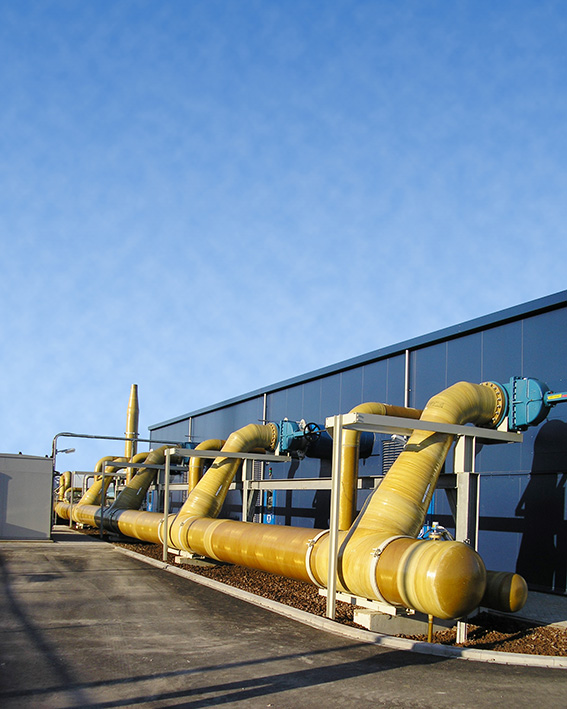

Many composite pipe systems are engineered for a service life of 50 years or more, depending on the application and operating conditions. They do not undergo metallic rust corrosion and are resistant to seawater, brine, chloride-rich environments, and common water-treatment chemicals, substantially reducing the corrosion-related maintenance associated with metallic networks. Their smooth inner surface means less friction and less energy needed to pump water every single day the system operates. And because they weigh a fraction of steel, they require less fuel for transportation and lighter equipment. None of these advantages is spectacular on its own, but added up over half a century, they make a real difference.
This is why I believe the sustainability conversation in infrastructure needs to move beyond the purchase price and the footprint of a single installation. A pipeline that keeps performing for decades, without linings to renew, sections to replace or leaks to chase, avoids the emissions and materials of building the same line two or even three times. That’s why we’ve published an independently verified Environmental Product Declaration for our pipes, allowing engineers, developers and utilities to assess their lifecycle impact on the basis of data.
And in a region where water is our most vital resource, data is crucial.
Undoubtedly, the greenest infrastructure is one powered by clean energy that is designed, from day one, to keep performing for generations.
Omar AlbusaidyIn 2023, a GCC official said the region aimed to lift desalination capacity by 37 percent over five years, backed by US$100 billion of investment. Desalinated water is precious: it takes significant energy to produce, and none of it should be lost to a corroded network. Our composite systems comprise some of the most significant water projects of this decade, from the Shuqaiq 3 desalination plant in Saudi Arabia and the Wave II East desalination project in Morocco, to the Hassyan SWRO desalination complex in Dubai (which is on track to become the world’s largest solar-powered desalination plant when fully operational). The same thinking applies beyond desalination, as shown by the Silicon Valley Clean Water project in California: a wastewater conveyance system designed to serve a city for decades. The pipes carrying seawater, brine and product water should be built to last just as long.
Durability will also decide how well the energy transition works. Hydrogen can diffuse into susceptible steel, reducing its ductility and fracture resistance over time, while adapting metallic networks comes at its own environmental and material cost. Composite offers a long-term answer. Our WAVISTRONG® GREEN (H2) series became the first composite pipe system certified to transport 100% hydrogen under real operating conditions, independently verified by TÜV SÜD, with substantially lower hydrogen permeation rates than comparable steel pipe systems. As the region’s hydrogen and green ammonia projects advance, the materials chosen today will help determine whether these networks are built for long-term performance.
The Gulf is building its next generation of water and energy infrastructure at a scale few regions have ever attempted. It has a real opportunity to build it to last, with durable, corrosion-free systems manufactured in the region, close to the projects they serve. Undoubtedly, the greenest infrastructure is one powered by clean energy that is designed, from day one, to keep performing for generations.
Build it once, build it right, and let it run.
