


British-Spanish artist Almudena Romero has grown the world’s largest photograph in wheat. Her choice of subject? A human eye. In our conversation with the artist, Almudena discusses her process, working with the French National Research Institute for Agriculture, Food and Environment, and co-creating with Earth’s shifting climate.
Deep in the fields of Toulouse, France, there’s a giant human eye.
From the ground, you’d see only multi-colored wheat stalks, carefully cultivated in the fields of the French National Research Institute for Agriculture, Food and Environment (INRAE), but from above, 11,000 square meters of wheat slowly take shape.
This ephemeral piece of art is the world’s largest photograph. Created by British-Spanish artist Almudena Romero, Farming Photographs holds up a mirror to humanity in one of our most crucial and insecure forms: our agricultural system.
Constructed in collaboration with INRAE, the eye represents three years of planning and a shocking number of extreme weather events and shifting temperatures. Almudena nearly gave up the artwork at one point, but she and the INRAE team persisted, finally achieving success in 2026. “So we couldn’t plant it in October 2024 because it was very wet,” Almudena explains. Planting finally went ahead in October 2025 only to face floods in February 2026. “I wanted to kind of say goodbye to the work then, but it did survive,” she says. “But then of course, you have the wettest February on record and three months later, you have the hottest May on record, so then the image disappeared a lot quicker.”
Art has a unique place within climate action, and Almudena has been co-creating with nature since she first discovered anthotypes during her studies. What’s an anthotype and how does it lead to giant pixels made of wheat?
Let’s back up a bit.
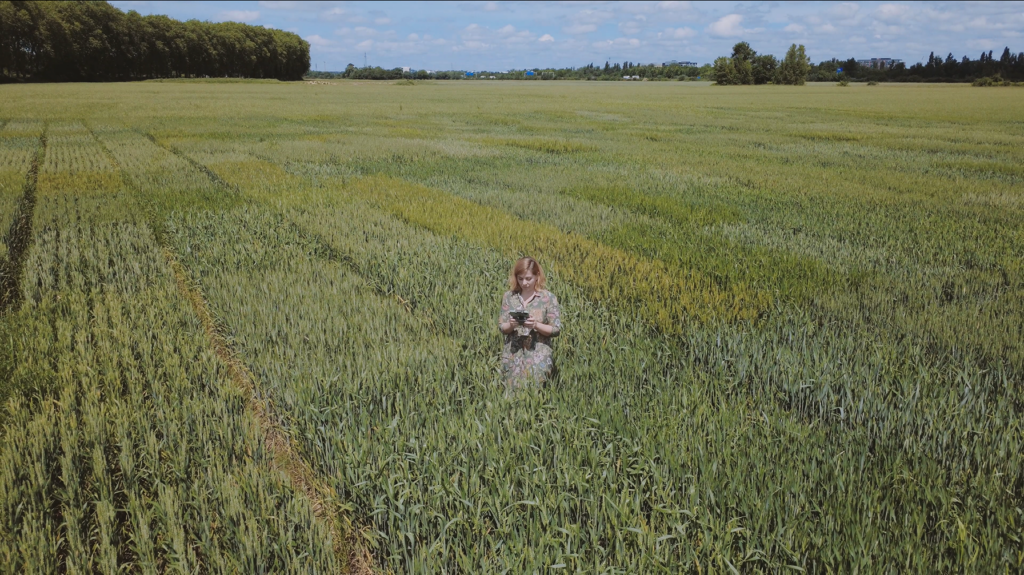
Almudena’s family originally hails from Valencia, Spain, and traditionally, they were farmers, a heritage that nurtured a sense of kinship with the researchers and farmers at INRAE. A journalist and photographer, Almudena studied at the University of Fine Arts in London, developing an expertise in 19th-century photographic techniques. This eventually led her to anthotypes, plant-based photography that uses plant-based pigments.
“Instead of extracting the pigments and coating fabric or papers, I wanted to see if I could use directly flower petals. I used the petal itself as a photographic paper, and from the petals, I moved to leaves.” From there came the idea of using living plants as a pixel. “And so I started to project with a projector onto plants, conditioning their photosynthesis to create a living image.”
As an artist working with a medium that grows, that wilts, that changes in the seasons, her creations are intimately connected to Earth’s climate. However, Almudena wanted to take her art a step further. “I wanted to expand my living photographic practice into something that is planted, that is rooted, and that is at the very edge of what could be understood as photography.”

But is Farming Photographs actually photography, you ask? While traditional concepts of the photograph center around the camera and the lens, at its heart, a camera is merely a light machine – its sensor records light through aperture and shutter speeds, creating an image for the human eye to interpret. In order to create the Toulouse human eye image, Almudena relied on pixels, essentially. Represented by 1,350 ‘pixels’, a plot of land measuring 1.83 x 4.5 meters (the distance between the wheels of a tractor), carefully sown in a field, in wheat varietals of varying colors, that when viewed aerially create a complete image. A photograph, though one that is thoroughly dependent on its environment, impermanent and ephemeral, but truly encapsulating the work, time, skill, and weather of its surroundings.
“I think many people question whether this is photographic or not, but to be sitting on that edge is something that I actually like. I think it’s important in the current climate crisis to expand the vision of photography beyond digital and analog,” she says. “And even though at the beginning it could be unsettling, I think that’s the case for anything that is a trailblazer: they are opening a path that for some people will be unsettling, but it’s a path that needs to be opened.”
The work is also representative of the incredible breadth of scientific knowledge at INRAE. The chromatic behavior of each varietal, the sowing density of each plot, the precision of the planting- all of this is down to the work of INRAE’s dedicated researchers and farmers.
I wanted to expand my living photographic practice into something that is planted, that is rooted, and that is at the very edge of what could be understood as photography.
Almudena RomeroIn October 2024, Almudena realized the urgency of climate change when massive storms caused unprecedented flooding in Valencia, Spain, her family’s hometown. “I must confess, I had this distant vision of, like, the Philippines are flooding and feeling as if it’s not really where I lived, but then it was where I was working and where I was living.” She shakes her head. “It’s not my first memory, but it’s the one that made me realize change needs to be right now.”
Farming Photographs is planted in Toulouse, France, a location that has been used as a European granary since Roman times, due to its perfect growing conditions. Researchers at INRAE have their own fields for testing and crop development. The wheat used in Almudena’s artistic process came from a number of wide varieties, most of which were being studied for characteristics such as heat, drought, and disease resistance; research deeply intertwined with food security as they attempt to cultivate species capable of withstanding our changing environment.
“There are many similar things between artistic research and scientific research. One of them is being used to the idea that you don’t know exactly where you’re going or what you’re going to get,” Almudena says, “So they had that curiosity too, which artists have.”
However, the past three years have illuminated the challenges of agriculture in an unstable environment. “It was a bit weird to plant European varieties in Toulouse, which is supposed to be the land of wheat in Europe,” Almudena says, “and see it failing several times.” It’s estimated that the 2026 heatwaves cost nearly €2 billion in damages to the European wheat industry, wiping out over 9 million tons of crops.
“Obviously, when for 15 consecutive days there was such a heat wave, the plant understood, ‘We’re in August.’” Time for harvest. Except, it was May. When wheat ‘spikes’ early, seeds inside the spike stop receiving nutrients. Seeds produced from these strained yields aren’t as adaptive and viable as those produced from stable years: the weakest generation for the toughest upcoming years.
The wheat grown for the project will be harvested and distributed to the surrounding community because it did ‘spike.’ However, Almudena notes that this only happened because temperatures dropped in January enough for the wheat to freeze, a necessary situation for that variety of wheat to grow successfully.
“It is quite alarming, to be honest, as an artist. To see the work struggling was sad. But I got a lot more worried as a farmer, because okay, the comments of the work are very pertinent, but actually this is a real issue for food now.”
Which is exactly why Almudena chose for her subject, the human eye. The creature most disruptive of Earth’s ecosystems? Humanity. “If the Earth had to protect herself from someone, it would be a human eye that they would design,” she says. One imagines the Earth designing a message to us all, carefully using the materials available to communicate the precariousness of our systems. “But I wanted to do it in a scale that is much bigger than a human eye; I wanted to do it in a scale that had this thing where we cannot fully see it.”
“We tend to think of nature as something we control, and we use for our purpose, and we exploit, and we extract, and we feel so superior, so wrongly. To have this monumental production where we are very small and lost in a field. And then there is this massive hyper object that is way bigger, even though it’s a human eye, is bigger than any human eye.”
Ocular mimicry is a natural defense mechanism. You’ve seen it on the wings of a butterfly, where its markings actually mimic the eyes of its own predators, “a look returned.” As we gaze at the human eye etched into the fields, we see ourselves looking back – our own worst predator.
As the image fades and the wheat is harvested, Almudena is already considering her next piece of living work; she’s committed to the lack of permanence, the short, sustainable cycles of nature as the foundation for her art.
“The next one is with cacti,” she says. Why? Because cacti can live about seven decades, a long time for a photograph. Naturally, cacti will come with their own challenges, particularly in cold or rainy weather.
“It will be this eternal struggle to work with nature and to comment on climate change while we are immersed in it,” Almudena explains. “But that’s precisely why I find it relevant.”
