


In Alsace, France, a husband and wife winemaking team is adapting to climate change and preserving the land. Julien and Sophie Schaal use organic and biodynamic methods to meet the shifting agricultural needs of a changing world.
Sophie Schaal hasn’t seen frost in Alsace in 13 years.
Which is odd, considering the vineyards of Alsace typically plant their vines higher off the ground than in other regions to prevent frost damage. It’s just one of many ways that climate change has impacted the storied wine region.
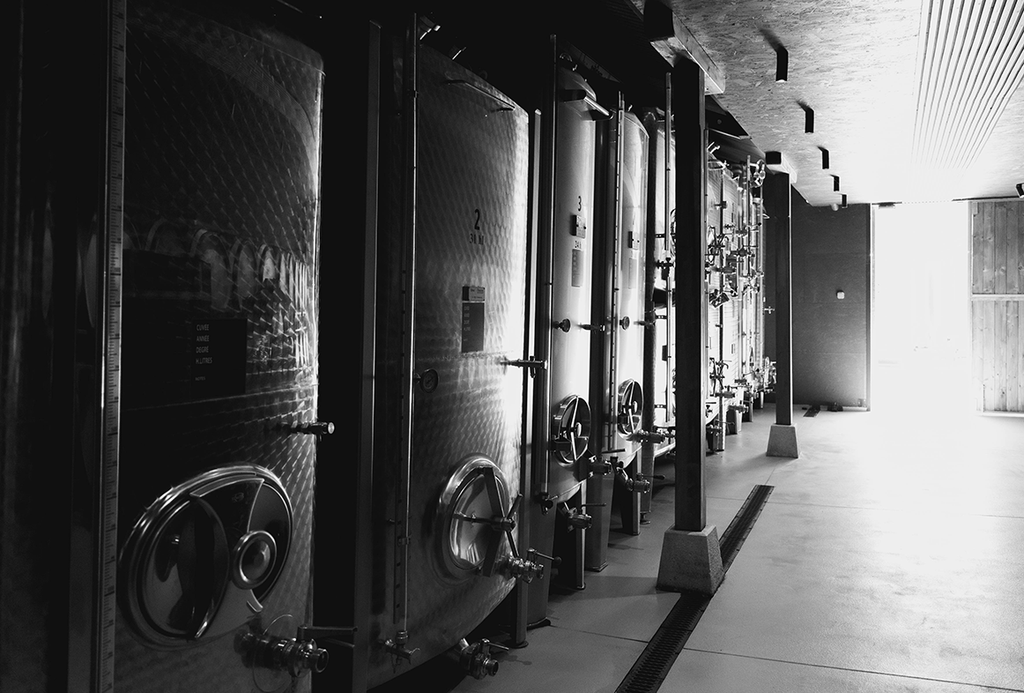
Julien and Sophie Schaal are a husband and wife winemaking team based in Alsace, France, and South Africa. Their beautiful home is nestled between vineyards outside of Colmar; behind the house, stainless steel tanks, aging barrels, and giant cement eggs are lined up in rows in the wine production building. For the pair, viticulture is intertwined with their family’s daily life, with Julien and Sophie each creating their own unique line of wines.
However, as with many farmers, they’ve noticed the extreme weather changes that have impacted their work. Alsace, France, rests on the border of Germany, on the Rhine River plain, where its limestone hills and cooler temperatures make it perfect for Riesling and other wines.
In the past, neatly trimmed vines were the order of the day, their tops straight and aligned, the sign of a well-kept vineyard. Today, sprigs are allowed to curl over the vineyard, freestyling across the lanes to protect the grapes from the sun’s intensity and provide shade. Harvests are unpredictable, shifting each year with increasing temperatures. Traditionally, grapes in the region would be harvested in October; now they’re harvested as early as mid-August. “Last year we started to pick on 22 August. This year it might be a week earlier again. A massive difference from one vintage to another,” Sophie says.
Winemakers must be flexible now, juggling unknown harvest dates, while ensuring there’s enough labor available, and still meeting production and bottling timelines. Like every other aspect of agriculture, wine has been affected by the shifting weather patterns and temperature changes of climate change.

As parents, Sophie and Julien felt the need to ensure their vintages were a part of the solution, not the problem. They’ve adopted an organic and biodynamic approach to their winemaking, their way of protecting soil health for future generations. “When you talk to people, they always think they’re going to lose volume by converting to organic because they won’t be able to use all the product they want. But it’s actually another way of working…it’s all about the knowledge that you’ve got,” she says. “And I think healthy ground, healthy soil is actually very powerful.”
Today, less than 13% of winemakers globally are certified organic, though the number is rising. However, getting an organic certification is a long process, lasting three years, and taking the plunge can be daunting for producers. Going organic means no pesticides or synthetic chemicals, relying on copper and sulfur instead for protecting against diseases and insects.
Transitioning to organic means going through a conversion phase as winemakers and growers must watch their vines carefully, checking to see how they fare without pesticides or more common treatments. “But it’s also the time for the vines to learn how to work differently,” Sophie explains. “We are going back to traditional methods because before all the pesticides arrived, we were working naturally, and it was the way of doing it because the product didn’t exist back then.”
To achieve balance sounds very easy, but it’s the most difficult thing to get. In wine, in food, when you cook, or in your life, having something in balance is the most difficult.
Sophie SchaalBeyond the return to the traditional, however, the Schaals felt that as parents, it was important to protect the land they worked on, preserving it for their children. “I think the most important thing for us was to see that it works. And I mean, it’s a very pragmatic approach. But why would you use chemicals if you can achieve the same quality, if not better, with organic? It’s a very healthy way to do it, and we’ve got enough chemical products and industry in all our surroundings.”
Even more than organic, however, Sophie is intrigued by the possibilities with biodynamic farming, a holistic process that follows lunar cycles and traditional herbal preparations to protect crops. In 2025, faced with nearly 100 millimeters of rain during harvest, the winemakers had to move fast to prevent rot on the grapes. “It was all about emergency and taking the most urgent grapes. So it was quite a bit of a challenge, but the vineyards that were biodynamic, they were the most healthy vineyards, really. And when you think, it’s only plant infusion and no treatments, not even the copper, but the vine is really treated to resist.”
Deep roots. Strong vines. Healthy vineyards. These are the most important things to Sophie. Well, that and taste. While we discussed the impacts of climate change on their process, she did note one interesting positive side effect she’d noticed: Pinot Noir. The famously fussy grape needs cooler temperatures and less rainfall, both conditions that are now present in the region. “Clearly, the Pinot Noir has been the one that has had the best benefits of it because obviously it can now really get the ripeness that it needs,” she says.
Unfortunately, that’s the end of the list for the positive side effects. For the rest, Julien and Sophie are trying to adapt to the extreme temperatures and unknowns as much as they can. “For vineyards, you don’t work on a short vision; you work long term,” she says, describing how many winemakers are now planting new varietals. “In particular, when you plant a vineyard in France, in Alsace, it’s for 80 years; it’s not for 15 years. So you’d better think twice before deciding what to plant and how to plant it.”
Most importantly, rising temperatures are changing the taste and mouthfeel of wine. “The key is to pick when it’s ripe, but the problem is that when you pick earlier, you don’t have the same time for the ripening season. The ripening season gets shorter and shorter just because it gets ripe quicker, faster.” Grapes might have reached their ‘sugar’ ripeness levels due to the increased temperatures, but the phenolic ripeness, the tannins, the flavonoids, the structure of the stems and the seeds and the skins, that can’t always be achieved with a shorter ripening season. “So you might have some bitterness, you might have some things that are not exactly ripe as they should be, because usually it needs a little bit more time. So it’s small parameters like that that we see that have an impact, and we have to adapt accordingly,” she says.
So far, the organic and biodynamic approach has worked for them, allowing Sophie to produce stunning pinot noirs and Julien to keep the grand tradition of Alsace rieslings alive.
And for Sophie, organic farming will be even more important in the future. “If your roots are not deep enough to go and have access to the nutrients in the water and in the ground, they would suffer even more from the drought, from the extreme conditions.”
But, with balance, Sophie believes they can continue to produce stunning wines and protect the natural world around them. “There is this very little moment where everything comes together, and it’s just the perfect moment to pick,” she says. “To achieve balance sounds very easy, but it’s the most difficult thing to get. In wine, in food, when you cook, or in your life, having something in balance is the most difficult.”
And that’s what they’re building in Alsace – balance with the Earth.
