


Omar Shihab, founder of BOCA, never intended to start a sustainable restaurant. Twelve years later, he talks regenerative hospitality, sourcing local produce, and developing a sustainable dining handbook that he hopes will change the industry.
Fine dining will always have a place as the venue of choice for special occasions. However, the industry has undergone a seemingly massive shift over the past few years, with changing diner tastes: the rise of the supper club, inflation, and even a change in how restaurants are perceived (see the 2022 comedy-horror film The Menu for more).
And if you’re trying to eat a more sustainable diet in our increasingly warm world, but you’re still looking for white tablecloths and an elevated dining experience, where do you go? Where does sustainability fit into all this?
Surprisingly, quite a few places in Dubai.
Omar Shihab, founder and executive director of BOCA, a homegrown Spanish concept, thinks any restaurant can be sustainable.
We spoke to Omar about regenerative hospitality, and he took us behind the counter (metaphorically) and into the kitchens of one of Dubai’s most popular restaurants, revealing the secrets of keeping their establishment delicious and climate-friendly.
BOCA was/is a Dubai classic. At the moment, the restaurant is in between locations as the original restaurant moves from its original DIFC home to a new one (BOCA 2.0). Alongside delicious Spanish cuisine (and its truly epic wine cellar), BOCA was also one of the first sustainable fine dining options in Dubai.
But it didn’t start like that.
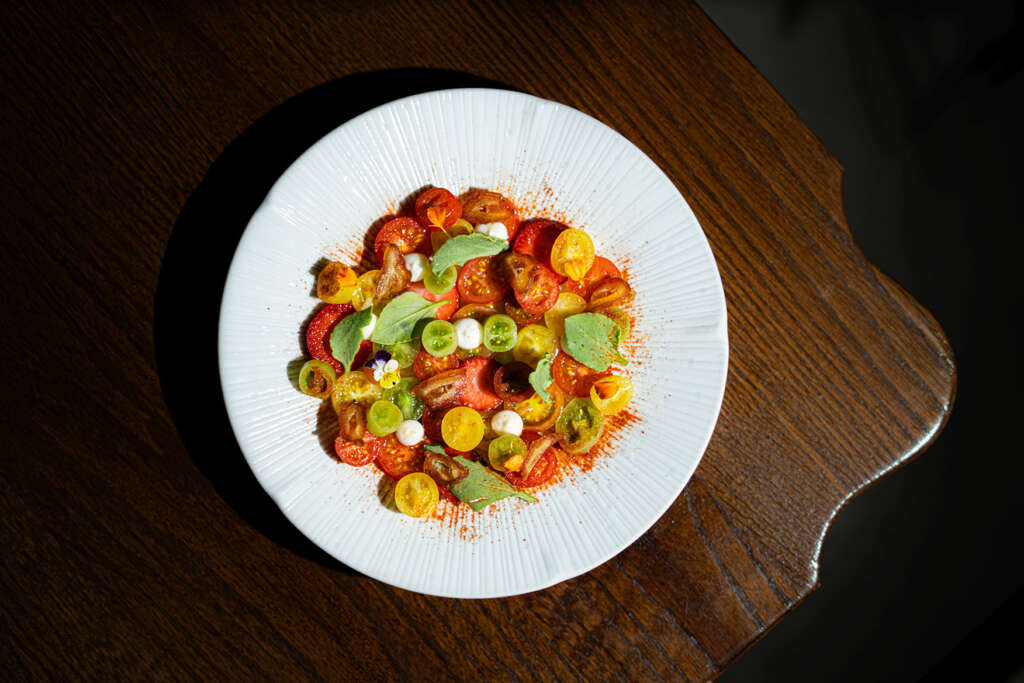
It Starts with Intention
Kind of.
How does one go about building a sustainable dining experience? Particularly in a city where diners have high expectations regarding ingredient quality, taste, and service?
Born and raised in the UAE (though his family originally hails from Jordan), Omar accidentally fell in love with hospitality (starting as an IT consultant in his youth), and his passion for true sustainability in the industry is infectious. When he founded BOCA, the intention wasn’t to start a sustainable dining venture at first. The idea was rather that the restaurant would feel homey, less restrictive: excellent food without the stuffy white tablecloths. “Dubai for the longest time was obsessed with imports. If a brand comes from a big city in the world, then it must be great; investing in big chef names to come through the UAE to Dubai to create familiar concepts. But we believed in the talents of the people living and working here,” he says.
“The initial ideas were creating a restaurant with a real sense of place regardless of the cuisine.”
Sourcing became the catalyst. Great ingredients, grown locally, would surely be more delicious than fancy, imported ingredients. Omar points out that this might seem trivial; surely everyone at the time was invested in using local ingredients? However, that’s not the case: many restaurants source luxury items from around the world. Asparagus out of season where you are? No problem, we’ll import it.
And thus, the emissions. Globally, the restaurant industry contributes around 18% of carbon emissions; more, if we add in cattle and other meat sources.
BOCA, it was decided, would go another way – it would head to the coast. With over 1,300 kilometers of coastline, the UAE has more coastline than land borders and overlooks two bodies of water. “So that’s what we looked at first, saying, ‘Let’s represent the fish and seafood that comes from here.’”
“And we wanted to do it with intention. Do we just go to the market? At the time, there was something called the ‘fishing calendar of the UAE’ that lists every species that lives in the waters and what the best months are to consume it. We found ourselves experimenting with fish varieties that you don’t usually see in commercial kitchens.”
This led to local oysters from Dibba Bay, menus that changed seasonally, and produce from local farmers grown in a variety of ways: conventional, organic, and hydroponic. Sourcing was just the beginning, but it had led to a new operational approach, one that was still delicious, but also better for the environment.

The Five Pillars
Hospitality is an emotional business. Reactive. Restaurants are often a marker of economic activity: a booming dining scene, and it’s clear that a town is thriving. However, a dip in local patrons or tourists, and inevitably, some establishments won’t survive. Where is the longevity?
Omar believes in systems that are sustainable from the top down, fully integrated from the start (he’s currently working on a sustainable dining playbook). His method involves five pillars: sourcing, waste reduction, energy and resource consumption, reporting, and community.
While certain choices might be simple, such as a menu that leans into plant-based dishes and choosing fewer, higher-quality meat sources, others take thoughtful integration. As BOCA started to measure its waste (over 6% of global emissions come from wasted food), they realized they needed a dedicated waste officer; One person assigned each rotation to manage the waste from each production area.
It’s not just about reducing food miles,” he says. “But supporting the local industry and telling the stories of these incredible people.”
Omar Shihab“I spent a considerable amount of my time trying to put together a sustainability framework for everything that we do in the restaurant,” he says. Reducing water consumption, choosing energy-efficient appliances and lighting, ensuring that correct maintenance schedules are adhered to so equipment is functioning correctly: “those are immediate wins that can be measurable because you have your electricity bills, you have your water bills, you have your chilled water bills.”
“It’s not just about reducing food miles,” he says. “But supporting the local industry and telling the stories of these incredible people.”
Everyone Can be Sustainable
Starting a truly sustainable business can be daunting. Many believe that sustainability is black and white: you either are, or you’re not. But that’s just not the case: no one can be perfect. And trying is always going to be better than giving up.
Every restaurant can be sustainable, though; it doesn’t require separate categories of dining. For some, it can be as simple as going into their backyard and their community to see what’s growing. It might mean incorporating native plants and traditional recipes; it could mean working with local recyclers or charity organizations to reduce waste (BOCA worked with the local companies to turn their used oil into biofuel).
Speaking of the UAE’s impressive deserts, Omar leans into the options these seemingly empty landscapes can provide. “These edible plants that grow in the desert, they provide certain flavors, they provide acidity, saltiness and brininess, bitterness. And if you just think of these ingredients as taste flavors, the possibilities are endless of integrating them into any cuisine.”
Let’s circle back to the fifth pillar: community. This aspect is often lost in the shuffle of the big ticket items (energy usage, recycling, waste), but how restaurants serve their community is essential. “How well you’re treating employees and staff, how well they’re compensated, their working hours, their conditions, their insurances, your inclusivity, your diversity.” These are all crucial aspects to running a business, Omar points out.
“And the restaurant is always a platform to receive people to discuss things that are important for that community,” he says.
Where Do We Go From Here?
Not everyone may be a foodie, but climate change is having a real impact on our food and water security. Soil degradation, increasing temperatures, shifting weather patterns – they each wreak havoc on traditional agricultural systems. Similarly, it’s changing diners too; 72 percent of consumers say they’ll pay more for sustainable restaurant meals.
“Sustainability is about maintaining what we have, but if what we have is being constantly degraded?” Omar asks during our conversation. “That’s not enough. We would rather come in and leave the place a lot better than when we found it.”
The Gulf is on the frontlines of climate change: drought, higher sea levels, warmer weather, bigger sand storms – these are all issues that the UAE is currently facing. The country has invested heavily in renewable energies and pollution reduction, but residents need to do our part as well.
Omar believes it’s more than possible for business owners to be part of the solution, rather than the problem. “It’s about energy conservation, it’s about efficiencies, it’s about doing more with what you have,” he says.
“It’s time to reimagine, rethink, take risks. So you end up with something totally original and beautiful and still has a real sense of place.”
