

Did you know there are between 2.3 and 3.8 million fungi species in our world, accounting for 90% of Earth’s unknown biodiversity? Yet, these ecosystem masters represent less than 1% of conservation funding. Thankfully, all that’s about to change. Enter Terra Expo City, Dubai, which hosts the world’s first IUCN SSC Centre for Species Survival dedicated to fungi. They’re solving the mysteries of mycology, one desert truffle at a time.
Sometimes, Georgina Pereira investigates mysteries.
The case: Witnesses reported signs of a desert truffle at the base of a Rock Rose plant out in the deserts of Dubai, but once Georgie is on the scene, the desert truffle is gone. The usual suspects? Spiny -Tailed Lizards or a hungry gazelle.
Georgie, a desert ecologist specializing in mycology and fungal conservation, leads the IUCN SSC Centre for Species Survival Fungi based at Terra, Expo City Dubai, and is the region’s first, and only, species survival manager assessing Macrofungi.
Her mission? To shine a spotlight on the overlooked heroes of our ecosystems.
Plants rely on them for survival. They regulate our climate, clean our ecosystems, and feed our communities. They hold extraordinary promise for the future of medicine, architecture, and fashion. These invisible architects have quietly shaped our world for billions of years, forming the very foundation of healthy ecosystems. To this very day, they’re still responsible for creating new ecosystems, the biological engine sustaining life on Earth.
Yet, they remain the most under-researched and under-protected group in biodiversity.
We’re talking about fungi.
Fungi are nature’s hidden heroes; they may even be the key to climate crisis solutions. And the UAE is blazing a trail to put fungi at the heart of global conservation efforts.
The Hidden World beneath Our Feet
Less than 0.2% of all conservation funding goes to fungi.
Why is an organism so crucial to our ecosystem so underfunded and undervalued? Probably because few realize just how significant they are, or even that they’re there at all.
There are between 2.3 and 3.8 million species of fungi in our world. Six to ten times the estimated number of plant species.
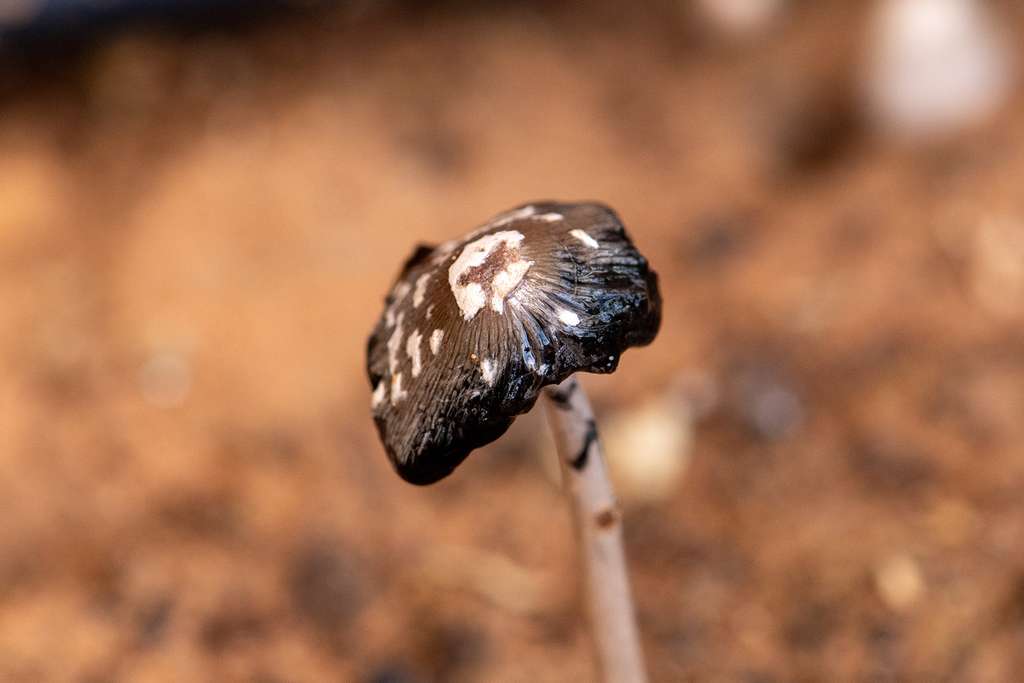
“It’s so easy to overlook fungi just because for most of their life cycle, we don’t see them. They’re hidden away, tucked away in their mycelial form. They’re not really the mushrooms that we’re used to seeing,” Georgie explains. These mycelia consist of vast branching networks of intricate, thread-like tendrils called hyphae. “For over 90% of their life, they’re completely invisible; but while they’re invisible, the magnitude of the functions that they play, the forms of biodiversity, and the ecosystems that they live in are incredible.”
We may not be able to sense the electrical signals and nutrients being shared among these undefinable organisms, but they exist. Plunge your fingers into the dirt, and you’ll unwittingly brush against thousands of microscopic connections or hyphae, a highway of life.
For over 90% of their life, they’re completely invisible; but while they’re invisible, the magnitude of the functions that they play, the forms of biodiversity, and the ecosystems that they live in are incredible.
Georgina PereiraThe second-largest kingdom after animals, fungi are all around us, from the tundra of Antarctica to the desert, deep sediments on the seafloor, and, in some cases, even inside us.
Despite being crucial connectors of nature, more than 90% of fungal species remain undocumented. Fungi account for roughly 90% of Earth’s unknown biodiversity; however, nearly one in three are threatened with extinction. While they mainly live hidden underground, everything above-ground depends on them: We simply cannot live without fungi.
Despite the wealth of fungal species beneath the UAE’s deserts, mountain ranges, wadis and coastal areas, Georgie bemoans how little is still known. “Every single finding that we have has the potential to be a new species entirely, just because we know so little from this area.”
Protecting ecosystems without considering fungal networks is a half measure. One that could lead whole ecosystems to collapse.
“Despite their key role in regulating the climate and sustaining global biodiversity, fungi have been overlooked in climate change strategies, conservation agendas and restoration efforts. This is a problem: the destruction of underground fungal communities accelerates both climate change and biodiversity loss,” says Merlin Sheldrake, mycologist and author of Entangled Life

What is the IUCN (and why does it matter?)
Across the UAE, over 500 observations have been uploaded to the iNaturalist app on the UAE’s Fungi project page. The moment fungi are reported, Georgie heads out to survey the area and bring the species back to Terra.
Time is of the essence.
Georgie works fast to get a tissue sample for DNA extraction, make a mycelial plate, then tag and dehydrate the specimen for the centre’s Fungarium before it disintegrates.
Kneeling in the sand in the deserts of the UAE (often she heads for locations outside the city of Dubai or in the vast reaches of the Abu Dhabi dunes), Georgie examines the ground for telltale hints of fungi: cracks in the earth hint at desert truffles, or small burrows may be home to lizards. “I’m constantly trying to figure out who’s eating all of these mushrooms,” she laughs. “I’ll often find little holes in the sand next to helianthemum where there could have been a truffle, but you’ll see gazelle hoof marks or fox trails; it really is a treasure hunt.”
Terra now hosts the first IUCN Centre for Species Survival in the Middle East and the first global Centre for Species Survival dedicated to fungi. Over the next 2 years, Terra will lead the charge on Red List assessments for fungi, but it’s not quite as simple as it sounds. “Red List training, for a mycologist, is so widely different to what it would be for anybody else,” explains Georgie.
The IUCN Red List of Threatened Species is essentially a checklist of taxa that have undergone an extinction risk assessment. Originally developed for animals, Red List assessments scientifically measure species extinction or the risk of ecosystem collapse.
The success and value of the project are undeniable. “Just getting pictures of fungi from all different angles and the substrate that they’re on is massively helpful for us to understand what that species might be,” explains Georgie. Although Red Listing an entirely new Kingdom isn’t without challenges. “How do you look at a cluster of mushrooms and figure out what generation they’re in, or what the population size is, or even when they came about?”
Conservation mycologists have pondered these questions for years. Thanks to the Centre, we finally have the answers.
“Our biggest project right now is our National Macrofungi Checklist,” Georgie explains. “There’s a massive gap in both data and the action that’s being done here, and we will never know how to protect them unless we first even understand that they exist.”
And in case you’re interested in mushroom hunting, the UAE’s first official annotated list of visible fungi will be published in conjunction with government authorities in 2027, alongside an upcoming Arabian Peninsula fungal database.
A Deeply Entangled Tistory
The cultural history of the mushroom is just as important as the science for Georgie. The desert truffle, coincidentally her favourite species, is the undisputed cornerstone of UAE ethnomycology (the study of how people have historically interacted with fungi). An ongoing project focusing on edible desert fungi aims to capture these stories.
“The Bedouins have incredible stories of the mushrooms that they would forage,” she explains; “stories that have not been captured by science.”
Known as fagha, the desert truffle is deeply rooted in Emirati history. Traditionally foraged by the Bedouins as they traversed the desert and revered as a blessing from Allah, they were an important source of protein in the otherwise inhospitable desert.
But predicting where they will grow is more art than a science.
These underground fruiting bodies of mycorrhizal fungi exist for most of the year as mycelial networks. In return for maintaining soil health and supporting plant resilience, desert truffles are sustained by their symbiotic relationship with the desert rock rose (Helianthemum lippii).
It’s a win-win for plant and fungus, and for the forager, the yellow-flowered shrub signals truffles nearby.
The Bedouins have incredible stories of the mushrooms that they would forage. Stories that have not been captured by science.
Georgina PereiraPoetically called Bint Al-Raad or “the daughters of thunder,” Bedouin folklore tells of truffles growing where lightning strikes the sand.
When thunderstorms drench the desert from January to April, the nitrogen-enriched soil allows truffles to fruit. As they expand upwards, they create telltale spidery cracks in the soil, hinting at the hidden treasure just below the surface.
Today, many Emirati families still carry on the tradition of annual foraging. “It’s really a family bonding activity,” says Georgie, “it’s a labor of love because they’re not easy to find.”
Local cultural traditions will play a part in the Red Listing process; Georgie plans to combine fungal biodiversity data and ethnomycological stories to protect both.
Georgie hopes to change the narrative of fungi, praising them as heroes of the ecosystem.
And the SSC Fungi is helping to do just that, raising awareness and strengthening conservation efforts through the Fungi Conservation Committee (FunCC), a global collaboration of mycologists and experts. The committee is working to help bridge one of the biggest gaps in our biodiversity data by launching the world’s first fungi-focused extinction risk research at scale.
Ecosystem Engineers
Thanks to these efforts, Portugal will have a Fungal Red List as part of their 2030 strategy for biodiversity conservation, and Brazil’s first Red List of Fungi Species has recently been published. “For the very first time, they were able to say, hey, 43% of our fungi are actually threatened, and they need to be looked after,” Georgie says. “It was the first time in the history of this massive country that they’ve been able to voice that.”
And in even bigger news, thanks to Georgie and fellow mycologists at the Fungal Conservation Committee, a new framework exists. At COP17 in Armenia, on October 21, the first Global Strategy for Fungal Conservation was launched. The framework encourages new fungal databases, increased conservation efforts, and supports the introduction of fungi into parks and green spaces.
Currently, Georgie and her team are spearheading IUCN Red List assessments for fungi in the UAE.
“We estimate that there may be around 10,000 species just in the Arabian Peninsula alone, and so far, nothing has been officially recorded. It’s starting from scratch, but it’s so rewarding.”
Georgie explains that public observations and citizen science are crucial to building out the conservation checklist. “If you see a mushroom, please click a picture and put it up on the project. It’s a very direct way to influence fungal conservation in the region. We fail to understand fungi a lot of the time because we don’t see the benefits immediately,” explains Georgie. They support plant health, carbon storage, ecosystem resilience, and nutrient cycling, and offer innovative potential across medicine, agriculture, architecture, and climate solutions.
It’s hard not to feel enraptured when talking with Georgie; her enthusiasm for fungi is infectious. And understandably so; the uncharted realm of fungi is nothing short of magical.
Their potential for changing the world? Exponential.
“If we were to think about how we can rebuild our relationship with nature and the planet for the long term, then I think fungi would be the key to success,” says Georgie.
Animation: Kaitlan Bachan
